



There was “absolutely no doubt that human-induced climate change played a role here in the preconditioning of the disaster”, said Dr Friederike Otto, a climatologist at Imperial College London who co-authored the study.
The World Weather Attribution study said the disaster was the result of a “compound event” caused by rising temperatures, thinning glaciers, thawing permafrost and pre-existing geological weaknesses.
The findings came as Nepali authorities significantly revised the number of people missing in the disaster from 5,179 to 6,150.
The death toll still remains at around 1,400, according to figures released on Wednesday.
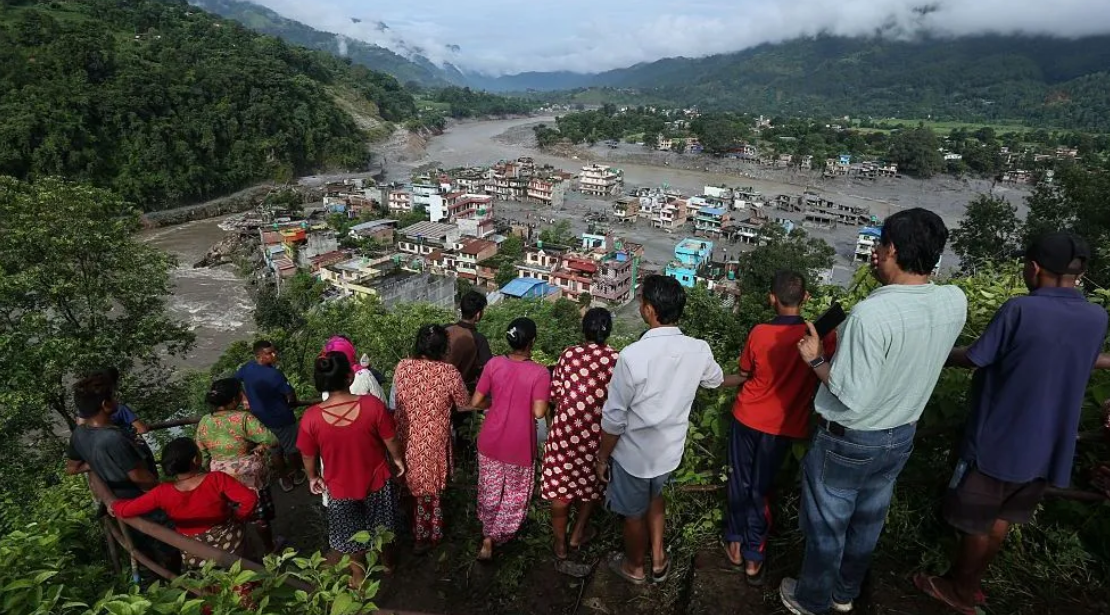
Massive floods and landslides swept through border towns and villages in Nepal and Tibet, wiping out thousands of houses, destroying energy infrastructure and leaving thousands dead or missing.
Scientists say the floods were caused by a collapse of rock wall and glacier icenear the peak of Langtang Lirung, a mountain on Nepal’s side of the Himalayas.
The collapsing debris hit the bottom of a valley with such force that it registered as a magnitude 5.2 earthquake, according to United States Geological Survey (USGS) data.
The World Weather Attribution study published on Thursday said climate change was a “destabilising factor acting on a pre-existing geological predisposition”, but it was not the only cause of the disaster.
According to the study, July and August temperatures in the area were around 1.5C (34.7F) warmer “due to human influence on the climate”.
Meanwhile, glaciers in the region had also been thinning by about half a metre (1.6ft) a year, which could weaken existing fractures and increase instability.
Heavy snowfall last October and November also added to a large amount of meltwater early this year.
This combination of activities “may have interacted to amplify the compound event,” the study said.















Leave a comment